
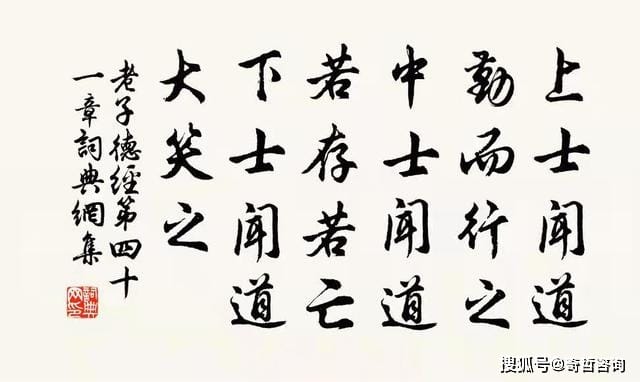
If you’re not familiar with Laozi, he’s the Chinese philosopher who essentially birthed Daoism. His book, Daodejing, lays the foundations for the philosophy of Daoism as a whole. I have never read Daodejing in its entirety, but I’d like to someday though. This is a quote from page 41, it’s a quote I’ve heard many times.
上士聞道,勤而行之。中士聞道,若存若亡。
下士聞道,大笑之。不笑,不足以為道。
The upper person who learns about the Way, practices it diligently.
The middle person who learns about the Way, keeps it and loses it.
The lower person who learns about the Way, laughs at it loudly.
If they did not laugh, it can’t be considered the Way.
This is my own translation of the original quote. I didn’t use any of the common english translations because many of those embelish the words a bit more, which I believe alters how one might interpret Laozi’s original message. Now I did not make it a completely literal translation, otherwise I would have translated the last line as “No laugh, no considered the Way”, but that sounds weird in english, so I made it a bit more coherent without deminishing the original words too much. One last note is that if you’re not already aware, “the Way” refers to the Dao, and Dao literally means way. It’s a super abstract sort of idea depicting nature, the universe, and everything.
Anyway, I first heard this quote from my grandmother who used to be a high school literature teacher in Taiwan, and the quote never really hit me until this year. At the start of Anthony C. Yu’s translation of Journey to the West, he offers this quote. And reading it over again now, I sensed a much deeper philosophy to it, and have thus spent the last couple days really thinking about what it means.
Before reading further, I encourage you to stop and read through the quote a couple times, and try to come up with your own interpretation first. It’s important to have freedom of thought. After you do that, continue reading and compare your own interpretation with mine.
The interpreting of this philosophy by Laozi poses a notable challenge for two major reasons. The first challenge lies in how finding a solid interpretation of the upper, middle, and lower person poses a considerable perplexity. At first one might associate these levels with the idea of class, status, or perhaps intelligence. These initial assignments ironically provide the exact process of thought that this phrase aims to explain, but that will be discussed subsequently. The second challenge lies in the final statement, which rigorously refutes many surface level interpretations one might have.
My interpretation of Laozi’s philosophy is thus: The upper, middle, and lower level of peoples refers not to one’s fixed position in any sort of tangible or intangible essence, but rather the fluid process of thought that exists within all beings.
The upper person demonstrates a completeness of thoughtfulness. They have achieved full understanding of a concept, and thus acts accordingly to demonstrate their belief in the now sensible concept.
The middle person demonstrates a partial understanding of the concept. They understand certain aspects of it, yet fail to grasp others. Many people who become stuck in this phase will perhaps believe in this concept at first, but will eventually abandon the idea as they cannot complete their comprehension. The upper person however, has achieved that fullness of understanding, and thus has moved on from this stage in the upwards direction rather than down.
The lower person laughs at the apparent absurdity of the concept. They simply formulate their thoughts based on the initial face of the idea, only skimming the surface of the concept. As aforementioned, the basic interpretation of the 3 levels representing something such as the division by class, status, or intellect is based on one’s initial interpretation of this phrase. These interpretations are based on what one usually associates with upper, middle, and lower levels. People who stop at this stage of thought are left in the lower level and laugh at the Way without obtaining a deeper understanding of it. What you demonstrate through continued contemplation of Laozi’s words is your thought process ascending through the middle and upper levels.
The final line does not serve as a new level, but rather a benchmark to establish the most basic level of Dao. All peoples are included in the confinements of Dao, and no person is exempt from thought. By this dictum, there is no one who “can’t be considered [in] the Way.” So why does Laozi include that last line if there’s no one outside of the Dao? I interpret the reason to be because it’s not intended to be a level that someone would be at. Rather, it’s an assertion on the idea that all people are capable of thought, and thus exists within the aforementioned levels of thought.
Here’s an applied example of my interpretation: Heliocentrism. When Nicolaus Copernicus was studying the concept of heliocentrism, it seemed absurd to most people. The people who simply heard about the idea of heliocentrism and didn’t think too deeply about it would laugh and scoff at the absurdity of the Earth moving through the universe. These people would exist at the level of the lower person. This doesn’t indicate that person is of low intellect or merit, just simply that they fail to provide the concept much contemplation.
Someone who learns about the idea of heliocentrism and spends some time thinking about it might find that it perhaps makes sense for the Earth to be moving around the Sun. This idea will solve some of the problems that exist in the geocentric model such as retrograde planetary movement. So they might accept Heliocentrism to a degree, but then they’ll question some aspects of the concept such as, if Earth is moving, why don’t we feel it? Not being able to progress your thoughts further will land you at the middle level, and you’ll eventually lose interest in the concept.
Then you have the person who learns about the idea of heliocentrism and thinks about it to a greater extent. Now we have Galileo. He learned about heliocentrism, and with a strong belief in it, dedicated his life towards studying the cosmos and refuting the rebuttals of it. That question the middle person asks about why we don’t feel Earth moving? Through deep thought and study, Galileo answers that question. We don’t feel the Earth moving because everything on Earth’s surface, including us, is moving at the same constant speed. Galileo offers the analogy that just as someone in the cabin of a ship wouldn’t be able to tell that they’re sailing through the ocean without any visual indication, we’re passengers on Earth, and without being able to view Earth’s movement from the outside, we can’t tell Earth is moving from our perspective. Galileo is the upper level of person here who delves into a deeper state of thought in order to grasp the full understanding of the concept of heliocentrism.
Lastly, there’s no person who would first learn about heliocentrism and not have at least some opinion or response to the idea. All people who respond with a variable degree of understandment, belief, agreeability, and insightfulness. Even a baby or animal would contemplate the idea if offered a more basic and visual way of presenting them the concept of the earth moving. For example, my old dog (who passed more than a decade ago) used to look out the window of the car and see that we’re moving, then she would look down at the floor and see that the floor of the car isn’t moving. She would look back and forth between the window and floor with a perplexed look on her face. This is the same idea as the Earth moving on a more local model. No one will have absolutely no thoughts about the concept of heliocentrism if they were to learn about it, and thus there wouldn’t be anyone outside of the Dao.
Laozi’s quote acts as a sort of theory of the process of thought and understanding. This map of 3 levels can be applied to a vast variety of concepts as different people have different levels of understanding and commitment to different subjects. Now of course there is no right or wrong interpretation in philosophy, but I believe my own interpretation here is quite solid and insightful. So I hope this inspires you to develop a more complete interpretation of this quote for yourself, and reach that upper person level.