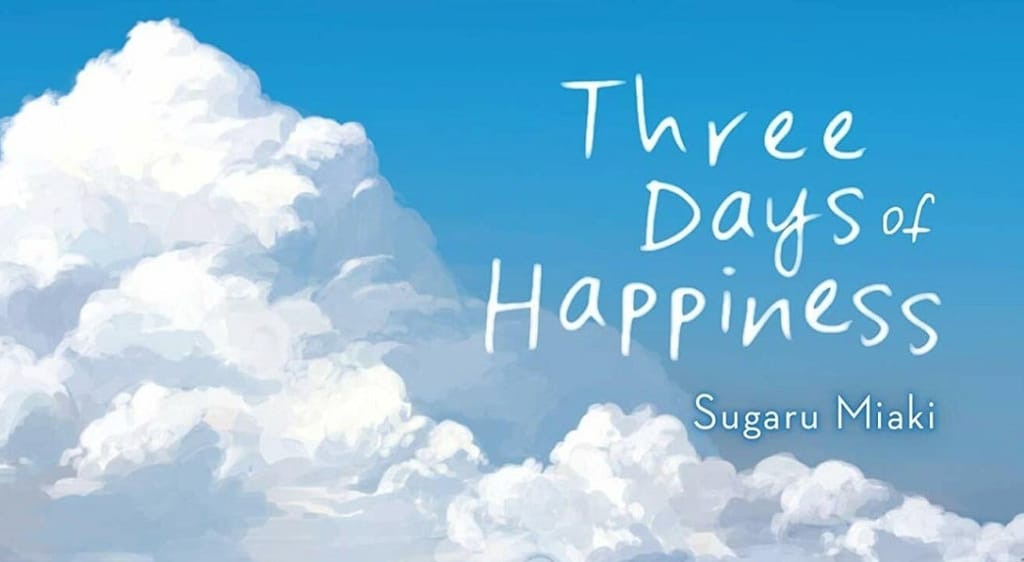
Hello, to make up for the lack of posts earlier in the year, I figured I’d share an essay I wrote in high school. Originally the essay was actually a comparitive literary analysis between Three Days of Happiness by Sugaru Miaki and White Noise by Don DeLillo, but the White Noise half of the essay while alright, is a massive drop in quality from the Three Days of Happiness half imo bc I rushed that half the night before the paper was due lmao. Cause I feel quite dissatisfied with the White Noise Half and I don’t particularly feel like rewriting it right now, I just cut that half out and am only sharing the Three Days of Happiness portion, which I feel I did a decent job on. I got an A- on this paper btw, most of the teacher’s criticism being in the White Noise half as expected.
Btw, White Noise is pretty good book imo that makes a lot of great points about the post-modern world through some great ironic humor and satire. I’d recommend giving it a read if you have time, not necessarily a high priority recommendation though. Anyway, I did make some minor adjustments like changing the title from “Duality in Consciousness of Mortality: The Influence of Death in Three Days of Happiness and White Noise” to the one below, but nothing too crazy.
Consciousness of Mortality: The Influence of Death in Three Days of Happiness
Death is the inevitable dusk of human life and thus serves as the greatest benchmark for the choosing of one’s life objectives. It is, however, only the people who recognize death’s contrast to life that are considerably influenced by the knowledge of their own mortality. The protagonists of the novels Three Days of Happiness by Sugaru Miaki and White Noise by Don DeLillo, Kusunoki and Jack Gladney respectively, offer prime exploration into this particular philosophy. In Kusunoki and Jack’s confrontations with death, their opposing responses reflect the dual nature of human outlook on mortality.
Kusunoki reflects the positive side of facing mortality. He represents someone whose life is at rock bottom, but through the realization of mortality reorients the values he holds in life to create meaning in his being.
Throughout his entire life, Kusunoki has held a significant disharmony with society. Particularly, his elementary school days is when his status as a social outcast became prevalent, “I look down on the children around me. I wasn’t clever or humble enough to hide my overbearing pride, and my classmates shunned me for it” (Miaki 3). This pride of Kusunoki’s is the key element that marked him as a pariah. It hindered him from being able to make the social connections that are vital in developing the skills necessary to become successful. Andrian Rahmat Hidayat writes in his critical analysis of Kusunoki’s social withdrawal, “his inability to build good social relationships and feeling alienated from his group indicate that Kusunoki had difficulty feeling a sense of industry” (Hidayat 24). Hidayat’s point in this analysis is that due to Kusunoki’s social isolation, he failed to develop a sense of connection with his peers, and by extension, with society. Additionally, Kusunoki’s prideful nature prevented him from making any progress towards improvement, leading to a future of depression and hikikomori, a term referring to prolonged and severe social withdrawal (Pozza et. al 1). These are the conditions that eventually led to Kusunoki’s nadir.
In a final act of desperation to attempt the resurrection of his life value, Kusunoki turns towards liquidating his lifespan. Still lost in his pride, Kusunoki assumes that “my childhood guess of three billion really was correct” (Miaki 19). Despite being at such a low point in his life, he still could not accept reality, as this hope was the only way to cope with his misery. Kusunoki desperately seeks the external validation that he was devoid of in his upbringing. Ultimately, the valuation of Kusunoki’s life came out to 300,000 yen (roughly $3,000 USD in 2013) in exchange for 30 years of his life (Miaki 20). This drastic contrast in price from his initial hope proved to be the fatal blow to his pride. Sun-Kyung Yee adds that “the quantified value of life prevents one from harboring false hopes” (Yee 327). Seeing such a worthless value placed on his life allowed Kusunoki to come to terms with reality and realize the crux of his superficial goals in life. Now faced with a mere three months left to live, Kusunoki becomes confronted with his impending mortality.
Kusunoki obtains a sense of liberation from the knowledge of his death. No longer bound by the utilitarian values of society, he creates a list of goals that he would like to accomplish before he dies: “Don’t go to college / Don’t work / Don’t hold back when you want something / Eat something delicious / Look at something beautiful” (Miaki 31). The first three objectives focus on rejecting societal value. Becoming educated, contributing to society through working, holding yourself back with a sense of integrity. All limits that restricted Kusunoki in his former life deprived of halcyon. Now that he is three months away from death, he is no longer constrained by those values. The last two points on the list will be discussed in the subsequent paragraphs. Miyagi, the person assigned to be Kusunoki’s monitor, comments on Kusunoki’s newfound liberation by aphorizing, “when death is imminent, they can finally see the relative brilliance of life regain some semblance of vitality” (Miaki 44). This comment directly applies to Kusunoki. Now emerging from his nadir, he is greeted with a fresh opportunity to recover his life value.
Kusunoki shifts his life objectives towards obtaining small, but fulfilling personal happiness. Now that death occupies a permanent seat in Kusunoki’s mind, the idea of obtaining worldly success and making his life worth 3 billion yen is fatuous. Instead, he shifts his goals towards activities such as “eating something delicious” (Miaki 31). Simply “eating something delicious” seems like a pleasure of minute value on the surface. It does not necessarily require much money, nor hard work, nor much difficulty. In Yee’s analysis of this novel, she claims, “these young people appear to harbor no desire for consumerism or success…they find happiness within their everyday reality” (Yee 326). This pertains to Kusunoki as there is no generally accepted value in an activity such as “eating something delicious” according to society. On a personal level however, simply eating tasty food can provide value beyond any realistic monetary amount, as it allows one to enjoy the limited time of life.
The greatest bit of small happiness that Kusunoki experiences, is pursuing his love for vending machines. He declares, “‘there is something I can truly say I love with all my heart’…‘I love vending machines’” (Miaki 109). Vending machines are not generally held in any sort of significance. They are a small piece of the societal landscape, visual white noise seeking no active attention. For Kusunoki though, they hold major significance, “vending machines are always there…they’ll give you something warm to eat or drink” (Miaki 110). For a person like Kusunoki who is so disconnected from society, vending machines provide a reliable and constant source of support for him. They are always there no matter what time of day it is, or what weather conditions there are. They will always provide him with warm comfort. Hidayat’s analysis shows that Kusunoki finds preference towards places with few people, as he is uncomfortable being among crowds (Hidayat 38). Vending machines provide the perfect solution for Kusunoki, as they require zero human interaction and are widely available in many locations, including places devoid of crowds. To pay homage to his love, Kusunoki embarks on a vending machine tour, taking pictures of all the vending machines he could find. His photos capture the individualism of each vending machine, such as how attractive each one’s lighting is, or the context of where they are located (Miaki 111). Akin to “eating something delicious” afore mentioned, taking pictures of vending machines is not attributed any substantial value by society, but to Kusunoki, it provides him with some of the most valuable experiences of his life.
Consciousness of mortality allows one to revel in the beauty of existence. The last item mentioned on Kusunoki’s list is to “look at something beautiful.” He fulfills this task by visiting a lake with a radiant starry night view, “it was possible to see stars as thick as paint spatter from a brush on the dark canvas of the sky…The starry sky was so, so much more immense than anything I had envisioned” (Miaki 120). Absorbing oneself in the grandeur of the expanses of the starry night sky offers prime conditions to contemplate the value of one’s life. In Kusunoki’s ponderance, he concludes, “I’d probably wish to pass away in peace, as though falling to sleep. To ask for anything else would be presumptuous” (Miaki 120). This is a pivotal statement in the development of Kusunoki’s character. He used to be filled with pride, a trait proved to be his fatal flaw. Now however, he seeks no excess luxury in his dreams.
Finally having found fulfillment in his life, Kusunoki extends his newfound happiness to his monitor, Miyagi. With only 33 days left for Kusunoki to live, he has completed his quest for reclamation. He decides to put the last month of his life to meaningful use by selling off 30 of his last days in order to pay off the debt of Miyagi (Miaki 159). This act of selflessness displays the complete transformation of Kusunoki. Hidayat highlights in his analysis that he no longer worries about being an outcast, and instead focuses on personal satisfaction and creating a positive impact on those around him (Hidayat 44). These 30 days were worth more than 30 years of his lifespan.
Kusunoki provides a prime example of the positive side of facing one’s mortality. He shifts his values towards a more fulfilling path, creating a meaningful finale for his meager life, and finally enjoying Three Days of Happiness in the end.
Here’s my conclusion too, it’s alright imo but I rushed to just get something on the paper. I believe it was like 6am by the time I was writing the conclusion lmao
Haidar Eid summarizes the philosophy of these works by beautifully aphorizing, “Consciousness of death requires a confrontation with death through a transformation from an obedient subject to an agent of liberation. That is to say, a consciousness of death is a consciousness of life” (Eid 3). Both novels provide opposing perspectives on how the knowledge of mortality can affect an individual. There are a multitude of alternative experiences one can have when confronting death. These novels, however, dedicate themselves towards tackling their own unique outlooks on mortality via the experiences of Kusunoki and Jack Gladney.
Here’s my works cited if anyone cares about that. Some of the sources are actually fairly interesting reads actually. I’m not bothering to weed out the White Noise sources, so I’ll just put them all here. Also the MLA formatting doesn’t nicely paste onto here, but it’s whatever.
Choi, Jaemin. “Death, Noise, and (Un)Plotting in Don DeLillo’s White Noise.” 서울대학교 미국학연구소, vol. 38, no. 2, 2015, pp. 111–28. hdl.handle.net/10371/95311.
D’Amato, Ilario. Illness, Fear and Uncertainty: A Medical Humanities Reading of Don DeLillo’s White Noise and the Appeal of Pseudomedicine. Dalarna University, 2026, www.diva-portal.org/smash/get/diva2:2038269/FULLTEXT01.pdf.
DeLillo, Don. White Noise: Text and Criticism. Penguin Books, 1998.
Eid, Haidar. “White Noise: Consumerism or Death.” Journal of American Studies of Turkey, vol. 13, Apr. 2001, izlik.org/JA79MW38RM.
Hamdi, Houda. “The Supermarket: Consumerism, Simulation, and the Fear of Death in Don DeLillo’s White Noise.” Language Literature and Interdisciplinary Studies, vol. 3, no. 3, Apr. 2020, https://doi.org/10.71106/nygj4507.
Hidayat, Andrian Rahmat. Severe Social Withdrawal of the Main Character in Sugaru Miaki’s Three Days of Happiness – Etheses of Maulana Malik Ibrahim State Islamic University. Universitas Islam Negeri Maulana Malik Ibrahim Malang, 2024, etheses.uin-malang.ac.id/id/eprint/70159.
Miaki, Sugaru. Three Days of Happiness. Yen Press, 2020.
Pozza, Andrea, et al. “The ‘Hikikomori’ Syndrome: Worldwide Prevalence and Co-occurring Major Psychiatric Disorders: A Systematic Review and Meta-analysis Protocol.” BMJ Open, vol. 9, no. 9, Sept. 2019, p. e025213. https://doi.org/10.1136/bmjopen-2018-025213.
Yee, Sun-Kyung. “The Genealogy of the Identity of Light Novel – Focused on the Self- Consciousness of Its Texts and the Communication Structure With Its Readers.” Journal of North-east Asian Cultures, vol. 1, no. 52, Sept. 2017, pp. 315–31. https://doi.org/10.17949/jneac.1.52.201709.018.
This essay covers the main topic of Three Days of Happiness that I find particular interest in. The idea of chasing after personal happiness rather than superficial status or value is something that’s stuck with me ever since I first read it, and I continue to abide by that philosphy to this day. My life has been vastly more enjoyable since then as I can just simple enjoy the things I enjoy.
The paragraph about Kusunoki looking at the stars is my personal favorite paragraph in the essay. While I was writing that paragraph it was 1am and I was just absorbed into that flow state feeling. The sentence “Consciousness of mortality allows one to revel in the beauty of existence” is easily the best quote I have ever aphorized, like not to glaze myself too much, but that’s such a beautiful statement lmao. I was also pretty happy with my introduction paragraph as well.
Anyway, idk how interesting this essay is to anyone, but I enjoy this half of the essay a good bit, so I figured it was worth sharing. Honestly, I feel like I can convey my thoughts about an anime or manga or LN better through my usual casual tone and style rather than a more academic MLA style, but I think I did a fairly good job conveying what I wanted to convey here. It also limited me quite a bit that we needed to have research sources incorporated into our essay, so we did have our freedomly slightly restricted. Anyway, that’s all I have to say for now, bye