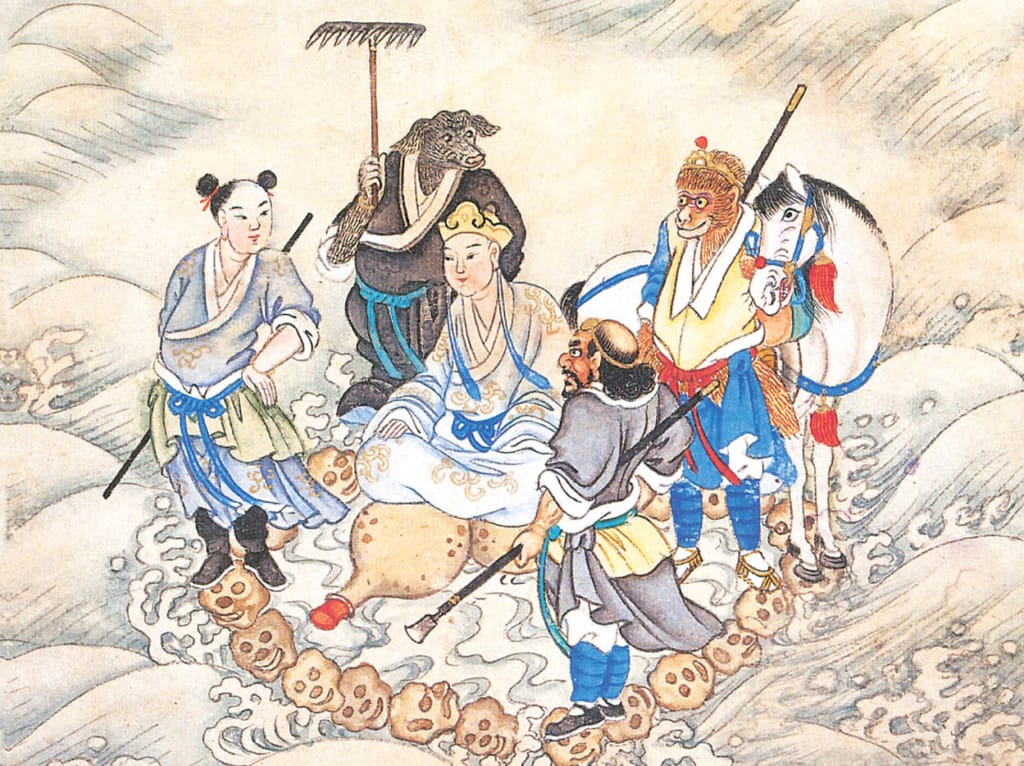
Not sure how long this post will be, but I’ll try not to yap too excessively lmao. Anyway, I’ve been reading Journey to the West, one of the 4 classic Chinese novels (even though it’s technically an epic), and I have been enjoying it very much. I’m a good quarter way through the story now, 25 chapters out of the 100 chapters. I’m reading the Anthony C. Yu translation, so that equates to finishing the first volume of 4. So anyway, I’ll give a few of my thoughts of it so far.
Background
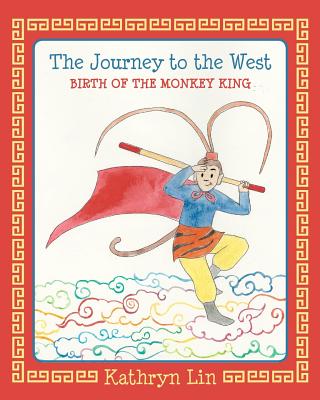
So I’ve been aware of the Journey to the West story from childhood as many other asian kids are. When I was little I had this children’s book that I loved which was a super watered down children’s version of Sun Wukong’s backstory. I always like Wukong because he’s funny mischievous monkey dude lmao. Besides Sun Wukong, I only really had a vague idea of what the rest of the story was. I knew about Zhu Bajie, the funny pig dude, and that it’s about a monk going to India for Buddhist scriptures. My mother and grandmother probably told me about some of the stories that are in Journey to the West besides the Sun Wukong backstory when I was younger, but I don’t remember to well if they did. I also didn’t realize that Dragon Ball was a parody of Journey to the West when I was younger either lmao. Since I knew about the story for a long time, I’ve been interested in reading the full thing for a while, but it’s a pretty hard read and is about 2,000 pages, so I put it off for a while, but started reading it this year.
So a little backround for the book itself now. Anthony C. Yu has a wonder 100 page introduction to the book, and I read about 20 pages of it, then said heck it, I’m gonna skip over the intro and read it later maybe, I wanna get to the actual story lmao. If you decide to read Journey to the West, I absolutely recommend the Anthony C. Yu translation as it’s the most complete translation and includes all of Wu Cheng’en’s poems in it, many of which are super well written and enjoyable to read imo. I’m not into poetry really, but I quite enjoy the poems in this book. Anyway, if you read this, just skip in the intro and read it later when you feel like it. The start of the book is a pretty slow read which I’ll talk about later, and you don’t want to discourage yourself from reading the rest by trying to get through a 100 page intro, so just skip it at first. There is however some important info about Buddhism and Daoism in the intro which will help you understand the book better if you don’t know much about them. I only knew a little about Buddhism and Daoism prior to reading, just the traditional things my mother and grandparents taught me, but honestly, as long as you make use of google to learn as you go, it’s not too hard to understand imo if you decide to skip the intro.
Another thing I find facinating, is that the intro points out that Journey to the West was actually inspired by a real life monk who Journeyed to India for scriptures. In the 600s, a Chinese monk by the name of Xuanzang, a name shared by the protagonist of Journey to the West, travelled to India under the rule of Emperor Taizong of the Tang dynasty, a figure who is also the emperor in Journey to the West. So Journey to the West’s setting is in part grounded in real life history and it’s premise in also grounded in history, ofc it’s still very much fiction beyond that though. There’s no irl Sun Wukong unfortunately lmao.
Story
So the first dozen chapters are the backstory before the actually journeying, which starts on chp 13. The first 7 chapters focus on Sun Wukong’s backstory, and the other 5 focus on Tang Sanzang’s backstory. The first 7 chapters, especially chapter 1, are extremely dense. There’s a ton of information to process about the world, the characters, and basically everything. If you don’t know much about Daoism and Buddhism, it becomes even more difficult. On top of that, it’s the start of the book so you need to learn and become familiar with Wu Cheng’en’s writing style. All this combined makes these chapters super difficult to understand, I actually ended up reading through the first 7 chapters twice. Don’t get discouraged though, because once you actually reach the journey to the west, the story just flows like a river, such a well engineer’s page turner.
Chapter 9 is about Tang Sanzang’s parents and the story of his birth and upbringing. I found this chapter absolutely facinating. My mother probably told me about this part of the story when I was younger bc it felt somewhat familiar, but I don’t really remember it. I was absolutely absorbed into the book while reading this chapters. It has certain elements of cliche mythology like the chosen one being put into the river by his mother as a baby to avoid danger, but for the most part, this story was extremely unique. The whole story was just so captivating I felt like I was watching a movie. Something Wu Cheng’en really excels at is imagery. Especially due to his poetry, which again is why I recommend the Anthony C. Yu translation, he details the visuals of characters, battles, scenery, ect so beautifully. Off topic real quick, in chapter 10, there’s a good 6 pages of a fisherman and a woodsman exchanging poetry and verses, and the writing is really immaculate. But yeah, I absolutely loved this chatpers. Even though it’s just a short 14 pages, it was so well written it could easily be a movie by itself. Even if you don’t read the whole epic, this chapter is definitely something I recommend reading. Also it’s a shame that the 1986 Journey to the West adaptation didn’t cover this chapter in depth, but it’s still the best film adaptation of the series imo so far.
Definitely take your time while reading the first dozen chapters. Don’t rush and allow yourself to take it in and adapt to Wu Cheng’en’s style and understand the world. Once your get to the journey chapters, you’ll start flying through them.
Poetry
I’m not going to go too crazy with the poetry since there’s literarly hundreds of poems in this book, but there’s 1 poem in particular that I wanted to talk about. In chapter 1 while Wukong is on his journey in search of immortality, we’re offered this beautiful poem:
When will end this quest for fortune and fame,
This tyrant of early rising and retiring late?
Riding on mules they long for noble steeds;
By now prime ministers, they hope to be kings.
For food and raiment they suffer stress and strain,
Never fearing Yama’s call to reckoning.
Seeking wealth and power to give to sons of sons,
There’s not one ever willing to turn back.
This is such a beautiful poem. The context of this poem is Wukong is traveling through human villages and is wondering why all these people are focusing on trying to attain wealth and power. They aren’t focusing on their own mortality like he is, and he finds that peculiar, and we’re met with this poem. While Wukong is our vessel for this poem, it’s really such a great statement about much of society on Wu Cheng’en’s part. I really resonate with this poem as it complements my own thoughts. In my previous post featuring my Three Days of Happiness essay, I composed the line, “Consciousness of mortality allows one to revel in the beauty of existence.” This line goes wonderfully with this poem as it talks about how being consered with death allows you to readjust your values and outlook on life. Society values people who seek wealth and power, but through realizing your own mortality, you might focus on your own personal happiness and goals instead. Rather than seeking excessive wealth and power for sons of sons, seek happiness and wholly fullfilment instead. Rather than longing for noble steeds and hoping to be kings, why not enjoy your attained mules and position as prime minister. No need to seek excess if makes you blind of your existing success. As Laozi says,
“Your name or your body,
What is dearer?
Your body or your wealth,
What is worthier?
Gain or loss,
What is worse?
Greed is costly.
Assembled fortunes are lost.
Those who are content suffer no disgrace.
Those who know when to halt are unharmed.
They last long.”
(Daodejing 44)
A great philosphy to abide by imo. There’s no reason to seek excess if you can find contentment in your existing state.
Conclusion
Well, I’m not gonna yap for too much longer. I’m not gonna talk about the actual journey yet since I’m still in the middle of it (and will be for the next 75 chapters lmao), but I’ll probably talk about the book again either when I reach chp50 or when I reach the end. So far I have been absolutely loving the book so much, gotta be one of the greatest works of literature I’ve read excluding anime related things. I absolutely recommend giving it a shot, but ofc take your time, it is a 2,000 page, 100 chapter epic after all.
P.S. I’m currently on S3 of The World God Only Knows, so perhaps I’ll make a post about that once I finish.