
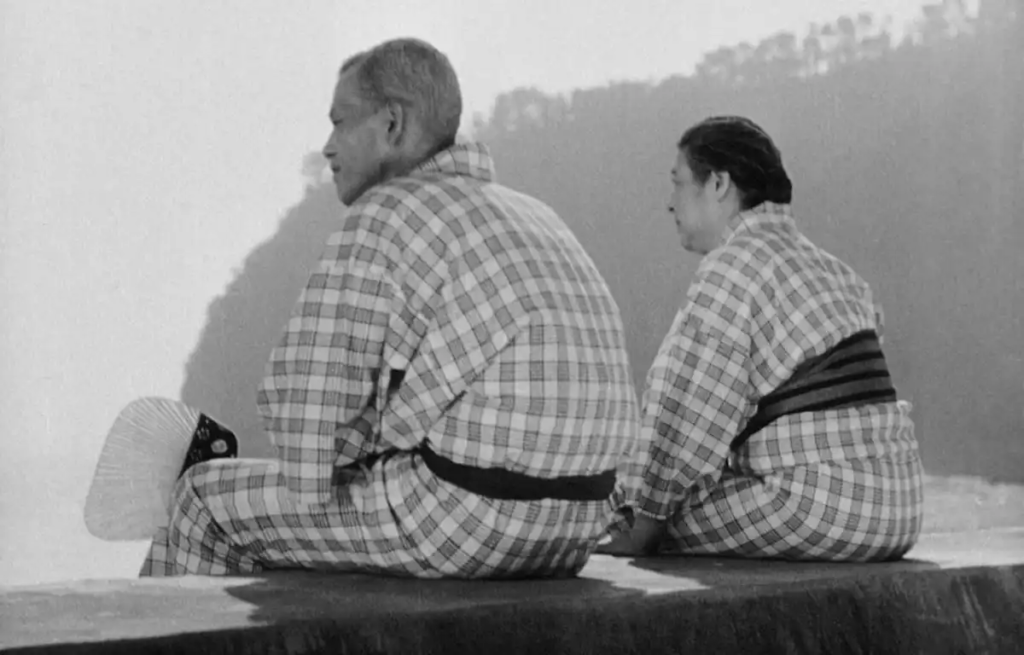
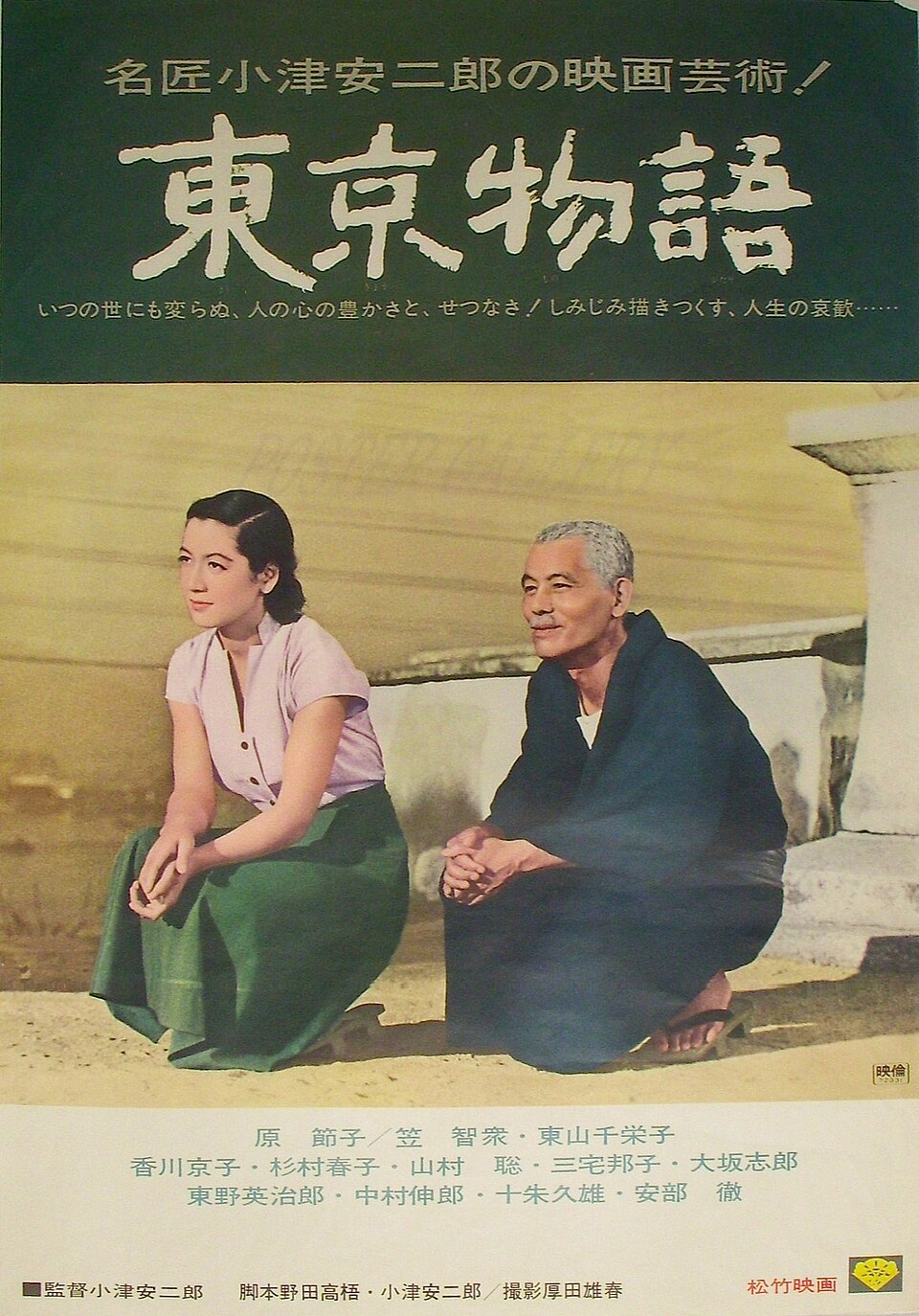
So, Tokyo Monogatari. I just watched it, and its reputation procedes it. It, put simply, is a masterpiece.
I’m not sure how long this post is going to be since I am writing this at 1:30am, but there is a few points that I absolutely want to talk about. So yeah, I’ll just get straight into it.
Old vs Modern
So one of the most defined themes in this movie is the old fashion vs modern. This can be seen in so many small details everywhere, from clothes, mannerism, dialect, how children interact with their parents, the way the elderly parents moved and talked slower while their children talk quickly and constantly rush. So many examples.
So seeing these elderly parents from rural Onomichi visiting their children up in Tokyo actually reminded me a lot of my own grandparents and great grandparents. My grandmother is from a farm in rural Hsinchu county and my grandfather was born in a small mountain village in Taiwan and raised in Fuli, a small village on the east coast of Taiwan. Both of my grandparents hail from rural areas (and their rural accent/dialect tends to come out when speaking chinese), but when they became adults they moved to Taipei to study in college and to work. So as adults Taipei is where they lived while my great grandparents would still be back in their rural homes. My mom has told me plenty of stories of when she would visit my great grandparents at their farm as a kid (my great grandmother was actually still alive until I was about 9 years old) and how she would help with preparing fresh chicken and stuff, though the actually slaughtering she couldn’t handle lmao.
But anyway, I’d imagine it was a fairly similar situation for them, not to mention that was around the same post-ww2 time period as when tokyo monogatari takes place.
I also wanted to mention dialect more. I noticed near the start of the film when they’re preparing to leave, I heard words like 行ってまいります、行っておいで、いってきなさい、and おはようござぁす rather than the more modern 行ってきます、行ってらっしゃい、おはようございます. This dialect different is such a sharp juxtaposition in the movie. This also connects to my grandparents and great grandparents. My great grandparents only spoke in Japanese, Hakka, and sometimes Taiwanese Hokkien, but my grandparents mainly speak mandarin. This is much more extreme than the simple dialect difference in tokyo monogatari since this is entirely different languages, but it’s still similar. My grandparents are used to speaking mandarin because that’s how they were taught under the rule of the KMT while my great grandparents were raised under Japanese rule when mandarin wasn’t really a thing in Taiwan at all.
Parenting
There’s the classic stereotype of asian parents. Always strict, rarely show clear affection, having a hard time saying I’m proud of you, expecting you to always do better. To certain extents many of these things are true among a lot of asian parents, and honestly, I’m not even a parent yet I find myself doing some of those things. We see an example of this type of classic asian parenting comments during the drinking scene mid-way through the movie around the hour. In fact, the one guy even at one piece straight up said “He’s a failure” about his son.
A few months ago my grandmother sent me this video clip of Jensen Huang, you know, the NVIDIA CEO, where he’s talking about traditional asian parents, and the thing that really stood out to me, was that he said “their way of showing love is to criticize you. That’s there way of saying ‘I love you, I want you to be better’”. This statement I feel is very true, at least for me. Sometime asian parents can get a bit toxic it feels, it might feel like you can never satisfy them, it might feel like they’re never proud of you, but asian parents are tsundere. If you get a 95 on an exam and they say “keep studying and get it to a 100”, don’t look at it as they’re dissatisfied with you and unhappy with the grade, view it as they’re proud of what you achieved and they believe in your ability to continue improving.
But of course, it’s not always the greatest feeling to always be criticized, so the father makes a great point in the movie when he says, “We can’t expect too much from our children. We can’t be greedy.” Sometimes it is better to just directly tell your kids that you’re proud of them. Tell them directly that you love them. Even though you show your love indirectly, it’s still nice told it directly sometimes. When I got accepted into my dream college that has only a 5% acceptence rate, my parents never congradulated me or said that they’re proud of me or anything like that. Despite the fact that I got accepted, I knew that either way I wouldn’t be attending that college since it’s way too expensive, but it was still a great achievement for me to even get accepted into such a challenging school. It would have been nice if my parents acknowledged it.
Another quote from earlier on in the drinking scene was this, “Talk about children, you miss them when they’re not around. If they are around, they’ll gradually treat their parents as a nuisance.” This feels especially true in the modern world, not just among asian families, but in many places across the world. In america this definitely seems to be true. Eventually children grow up, they start working, they have kids of their own, and they just get busy. They don’t have the time or energy to care for their parents like they used to. Especially in the modern world where both husband and wife are working. I’ve honestly been guilty of this myself, when you’re just busy, you unintentionally push you parents to the side.
I’ve also wondered about how it would feel to be a parent whose children have all moved out. You’re probably in your last few years of work or already retired, and all of a sudden all of the time in the world just hits you at once. Your responsibility of taking care of your kid for the last 20 or so years has been released, your time in society’s work force is coming to an end, I can’t imagine how it must feel. It’s gotta be a mixure of a weight coming off your shoulders, but a void forming in your heart, a mix of a relief yet also sadness. Such a bittersweet feeling as your kids are now grownup, but no longer by your side. And that feeling must be even greater when your kids live some place far off from you so you can’t just drive down the road to visit them.
Conclusion
Well, I only ended up writing 2 sections, but I’m already passed 1,100 words and it’s 2am, so I’m gonna go to sleep.
This movie was genuinely a masterpiece, and all of its themes I feel absolutely still apply to current times. I will say I teared up a bit at the end too. Also something else I wanna mention, the general lack of much music throughout the movie was powerful, very powerful. Silence is so well utilized in the movie, and the scenes of the 2 elderly parents just quietly existing by eachother’s side were so refreshing. It reminded me that the world doesn’t need to be a constant string of stimulation.
So yeah, definitely watch this move, bye

Leave a Reply